How to Choose an Outdoor Backpack: Trekking, Camping and Hiking

Choosing an Outdoor Backpack: Everything You Need to Know About Trekking, Camping and Hiking Packs
When buying an outdoor backpack it is not enough to ask, “How many liters?” Of two packs with the same capacity, one may feel balanced and comfortable for miles, while the other may tire your shoulders on a short hike. The difference is not just the volume: the suspension system, torso fit, hip belt, load distribution, organization, materials and intended use all work together.
In this comprehensive guide, we explain the differences between outdoor, trekking, camping, hiking and tactical backpacks, then cover capacity, torso length, rain protection, packing and the details to consider before buying. We also compare real technical specifications of different models in the Ersin Outdoor range.
- Quick comparison of outdoor backpacks
- Different types of outdoor backpacks
- How much capacity do you need?
- Why the back system matters
- How do you adjust a backpack properly?
- How heavy should your backpack be?
- Waterproofing and rain protection
- Pockets, zippers, MOLLE, and other details
- How do you pack a camping backpack?
- Bushlove 50 L Lazer Cut: Four colors, one model
- How to assess value for money
- Outdoor backpack brands
- Common backpack buying mistakes
- Interactive Purchasing Checklist
- Frequently Asked Questions
A Quick Comparison of Outdoor Backpacks
When comparing outdoor backpacks, it’s important to realize that the same liter capacity doesn’t necessarily mean the same usage characteristics. For example, a 50-liter tactical backpack and a 50+10-liter adjustable trekking backpack may carry a similar amount of gear; however, their organizational layouts, back systems, and intended purposes differ.
The products below represent different types of backpack and intended uses. Check the individual product or category page for current availability before making your choice.
| Model | Image | Volume | Weight | Back / Carrying System | Key Details | Best Suited To |
|---|---|---|---|---|---|---|
| Bushlove Lazer Cut Tactical Large Value for money MOLLE |
 |
50 L | Not specified on the product page | Waist stability strap | 5 compartments, internal organization, fully opening main compartment, laser-cut MOLLE system, 53 × 33 × 30 cm | Tactical use, camping, vehicle kits and multi-compartment organization |
| Husky Rony 50 Trekking |
 |
50 L | 1,700 g | Adjustable DER back system, EVA and 3D mesh | Rain cover, hydration bladder compatibility, two main compartments, removable top lid | Designed for walking and classic trekking |
| Ferrino Overland 50+10 Trekking |
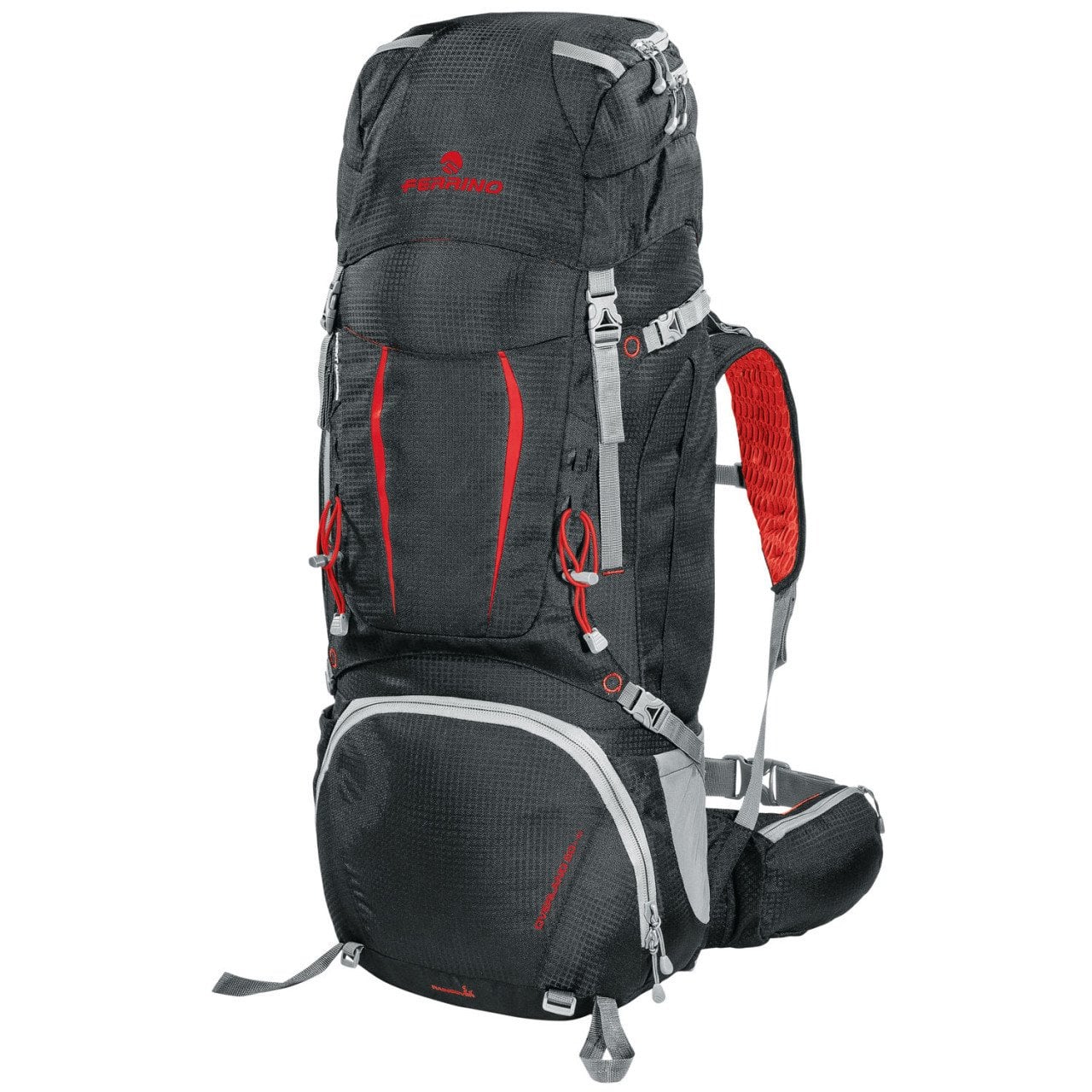 |
50+10 L | 2,350 g | Support panels, ventilated back and hip-belt construction | Rain cover, hydration compatibility, sleeping bag compartment, removable top lid | Trekking with a tent and multi-day camping |
| VAUDE Astrum EVO 55+10 Women's Women's Trekking |
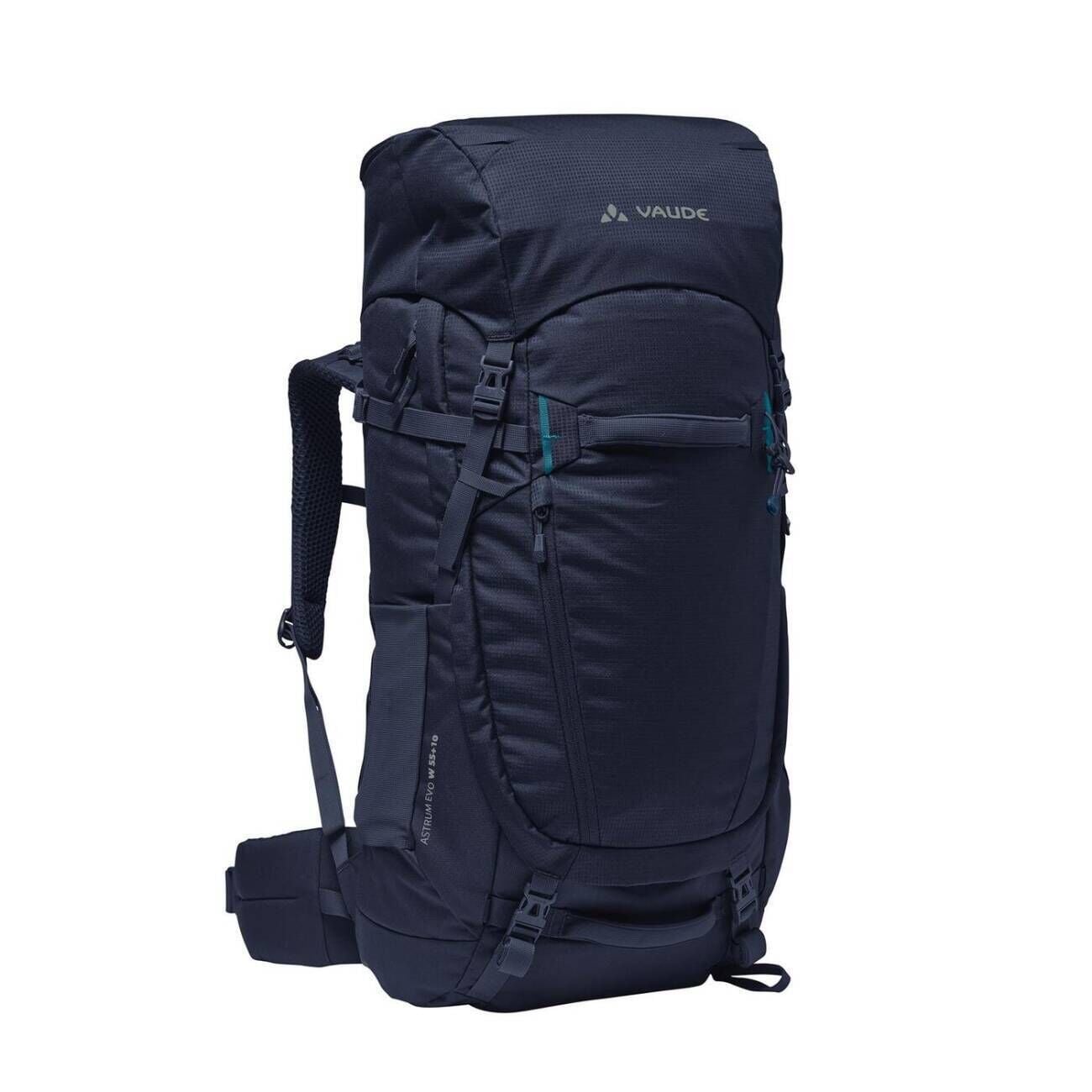 |
55+10 L | 1,760 g | Adjustable support system, ErgoShape shoulder straps designed for women | Specified weight range: 15–22 kg; dimensions: 74 × 34 × 31 cm; made from recycled materials | Long-distance trekking and carrying designed for the female anatomy |
| Deuter Aircontact Core 50+10 Long-distance trekking |
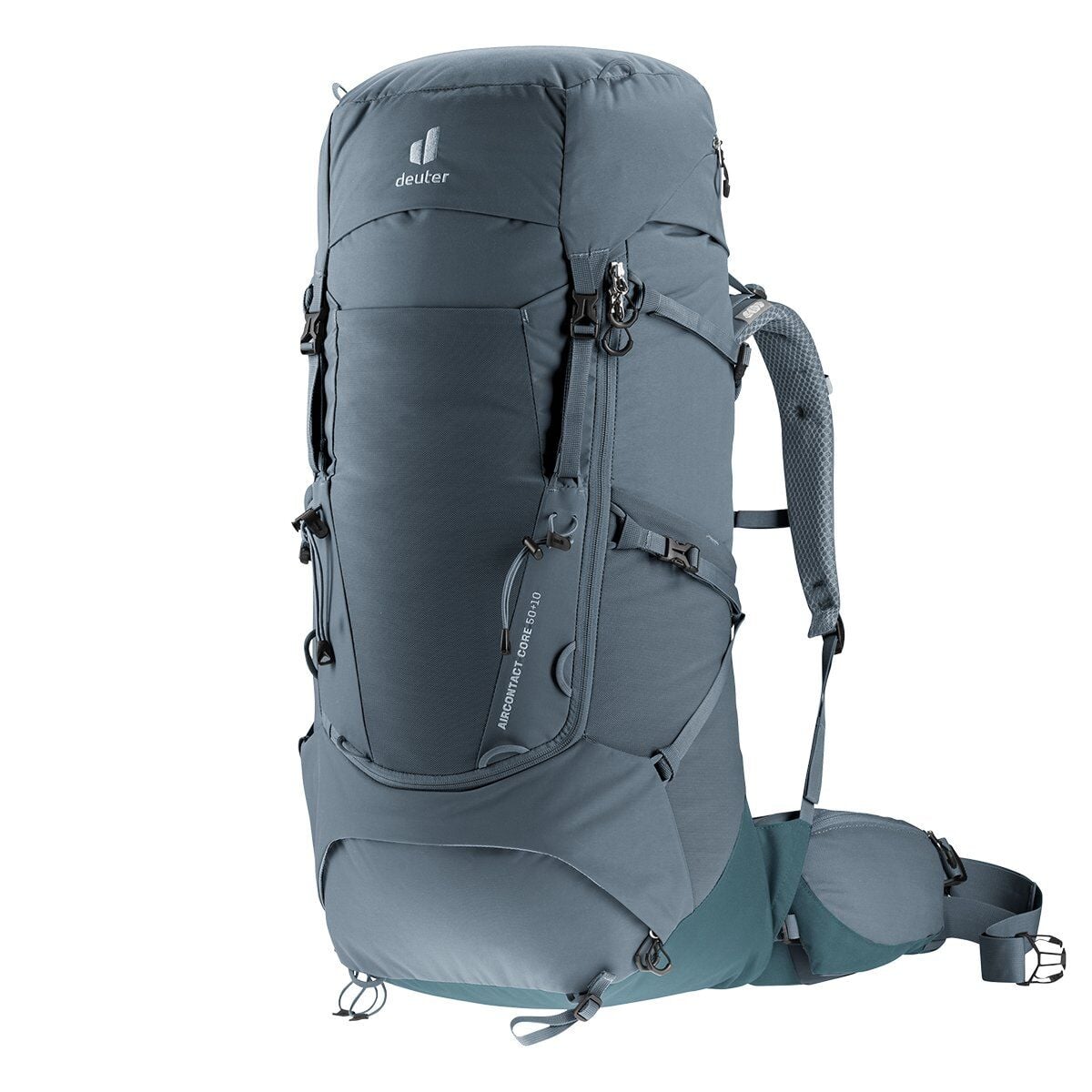 |
50+10 L | 2,160 g | Aircontact, VariSlide, VariFlex, and Y-frame | 42–62 cm back length, rain cover, compatible with a 3 L hydration system, recommended load: 15–20 kg | Long distances, heavier loads and an advanced carrying system |
Are Outdoor, Trekking, Camping and Hiking Backpacks the Same?
In everyday use, these expressions can be used interchangeably. However, there are distinct differences between them in terms of usage scenarios.
How Many Liters Should an Outdoor Backpack Hold?
“How many liters should a trekking backpack hold?” This is one of the most common questions about outdoor backpacks. However, the correct answer doesn’t depend solely on how many days your trip will last. The compressed size of your sleeping bag, whether you’re sharing a tent, the amount of winter clothing you’re bringing, your water needs, and how compact your gear is can all significantly affect the volume.
In REI’s backpack guides, volume is also evaluated in conjunction with trip duration, the amount of gear, and carrying preferences. For 1–3-night trips, approximately 30–50 liters is recommended, while larger volumes are recommended for multi-day trips.
For a more detailed comparison by capacity, see our guide: How Many Liters Should an Outdoor Backpack Be? Comparing 20 L, 40 L and 65 L.
Why Can the Back System Matter More Than Capacity?
When two 50-liter outdoor backpacks are placed side by side, their volumes may appear to be the same. However, the difference between them becomes apparent when a load is added. The purpose of a trekking backpack is not merely to have the weight rest on the shoulder straps; rather, it is for the body of the backpack to fit snugly against the body and for a significant portion of the load to be transferred to the hip area.
For this reason, the following components should be evaluated together on long routes:
Torso length matters more than your height
Overall height can be misleading when choosing a backpack size. Backpack fitting guidance emphasizes torso length as the key measurement. It is generally measured from the C7 vertebra at the base of the neck to the level of the top of the hip bones.
For longer hikes, check the model's stated torso-length range. The product listing for the Deuter Aircontact Core in this comparison, for example, specifies 42–62 cm.
Why is a ventilation system important?
Air circulation between the back panel and the body affects comfort, especially in hot weather. Mesh panels, air channels, or manufacturer-specific back systems can help reduce the feeling of sweating. However, good ventilation alone is not enough; a poorly adjusted backpack can be uncomfortable even with the most advanced back system.
How Do You Properly Adjust an Outdoor Backpack?
The reason a newly purchased hiking backpack feels uncomfortable isn’t always the product itself. Tightening the straps in the wrong order can cause the weight to shift onto your shoulders or pull the backpack backward.
How Heavy Should an Outdoor Backpack Be?
This question has two distinct meanings: the backpack's empty weight and its total loaded weight.
A very light backpack is not automatically better. To save weight, manufacturers may use thinner shoulder padding, a lighter frame or simpler organization. If you will be carrying a heavy load, a robust suspension system may matter more than saving a few hundred grams on the pack itself.
As a general guideline, it is recommended that a day hike load not exceed approximately 10% of the user’s body weight, and a backpacking load not exceed approximately 20%; however, these figures are a general starting point that may vary depending on personal fitness, the route, equipment, and health status.
Are Outdoor Backpacks Waterproof?
“Waterproof outdoor backpack” is a common search term, but water-resistant fabric and a fully waterproof construction are not the same. A water-resistant outer fabric does not guarantee that zippers, seams and the rest of the pack will remain watertight during prolonged rain.
For this reason, it is important to read the product description carefully. If the product page does not explicitly state “waterproof” or specify a particular waterproofing standard, it is incorrect to assume the bag is waterproof based solely on its appearance or the thickness of the fabric.
REI also offers separate rain covers designed for different liter capacities; this illustrates why external rain protection is a common solution for classic hiking backpacks.
What Features Should You Look for in an Outdoor Backpack?
1. Hip belt
For larger packs, especially those above roughly 40–50 liters and designed for heavy loads, a padded, load-bearing hip belt is very different from a thin decorative waist strap. For heavy trekking loads, a belt that securely wraps around the hips becomes essential.
2. Sternum strap
It helps keep the shoulder straps in place. If it’s too tight, it can make it hard to breathe and restrict shoulder movement.
3. Compression straps
When the bag isn't completely full, it helps maintain its shape and minimize movement of the contents. It can also be used on some models to secure appropriate gear to the outside of the bag.
4. Bottom compartment
It’s useful for a sleeping bag, camping shoes, or any gear you want to keep separate. However, everyone has different usage habits; a user who does minimalist trekking might prefer a single main compartment.
5. Front or side access
With a large bag that opens only at the top, you may have to empty the entire bag just to reach items at the bottom. A U-shaped, J-shaped, or full-circumference zipper opening makes this much easier.
6. Hydration system
For hikers carrying a water bladder, an internal reservoir compartment and a hose outlet may be important. If you don’t need this feature, you don’t have to choose a more expensive model just because it has it.
7. Trekking pole and technical gear attachments
Attachment points for trekking poles, an ice axe or a helmet may be important, depending on the activity. For predominantly urban or camping use, these features may not be necessary.
8. What is the MOLLE system?
The MOLLE system allows compatible pouches and accessories to be attached to the outside of the bag in a modular fashion. It is particularly common in tactical backpacks. Its advantage is customizable organization; its disadvantage is that the bag can expand and become unstable when too much equipment is attached to the outside.
How to Pack a Camping Backpack: Load Distribution
Even an expensive hiking backpack can be uncomfortable to carry if it’s packed incorrectly. It’s important to distribute the weight evenly from side to side and to avoid placing heavy gear too far away from your body.
REI’s packing guide also divides the backpack into sections: bottom, center, top, and outer pockets; placing heavy and bulky gear toward the center of the backpack, close to your back, can create a more balanced center of gravity.
Bushlove Lazer Cut 50 L: Four Colors, One Model
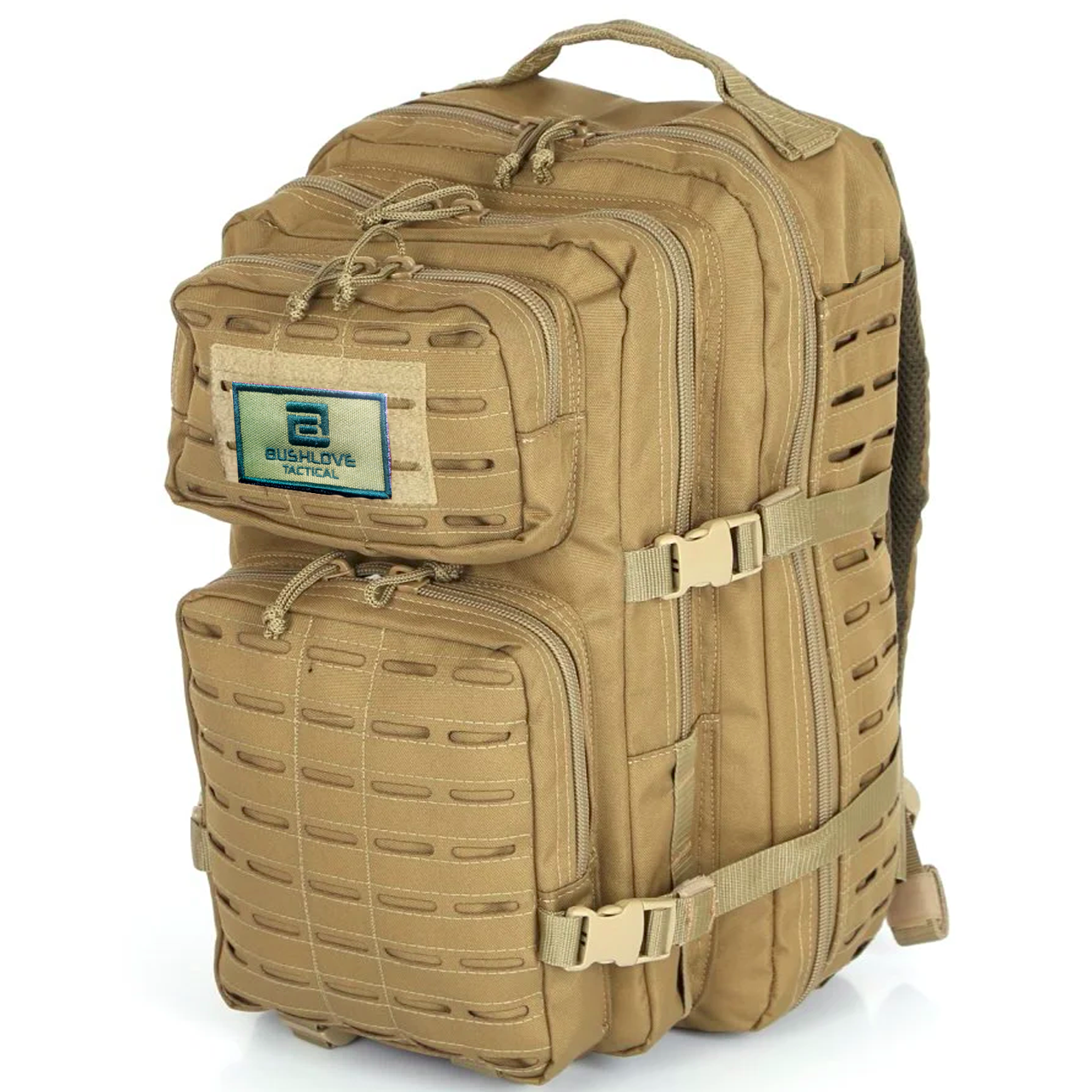
Although different colors of the Bushlove Lazer Cut Tactical Large are listed on separate product pages, they are technically the same basic design. Rather than treating the four colors as different packs, consider them color options of a single 50-liter model.
 Beige
 Khaki
 Gendarmerie Camouflage Black
Verified features of the model
- 50 liters of capacity
- 53 × 33 × 30 cm dimensions
- Five main compartments
- Additional organization within the compartments
- Wide zippered opening to the main compartment
- Internal zippered compartment
- Waist strap for stability
- Laser-cut MOLLE system for attaching compatible additional pouches
The listing does not specify the pack's empty weight, an adjustable trekking-specific suspension or an included rain cover, so we do not assume that these features are present.
Bushlove 50 L: How Does It Compare for Value?
To make a fair comparison here, we first need to make an important distinction: the Bushlove Lazer Cut 50 L is not in the exact same product category as models with advanced trekking suspension systems, such as the Deuter Aircontact Core or the VAUDE Astrum EVO.
In the case of Deuter, there are more comprehensive carrying technologies designed for long-distance trekking, such as VariSlide, VariFlex, Aircontact, the Y-frame, specific back length, and recommended load information. The VAUDE model features an adjustable support system and ErgoShape shoulder straps designed for women’s anatomy; the Husky Rony features the DER adjustable back system; and Ferrino stands out for its trekking-focused support and organization features.
Where Bushlove excels
- 50 L capacity
- Multi-compartment organization
- Wide, suitcase-style access to the main compartment
- Ability to expand external organization with MOLLE
- Tactical and outdoor use in one design
- A practical value-oriented alternative to similarly sized technical trekking packs
The advantages of technical trekking models
- Published empty pack weights
- Adjustable torso-length and back systems
- More specialized load-transfer technology
- Included rain cover on some models
- Hydration system compatibility
- Recommended load ranges specified for certain models
In other words, rather than simply choosing the least or most expensive pack, invest in the features you actually need rather than technology you will not use. That is a better way to assess value for money.
Outdoor Backpack Brands: Which Brand Is Right for You?
There is no single answer to the question of the best outdoor backpack brand. Even within the same brand, you may find daypacks, 70+ liter trekking packs, tactical backpacks and cycling bags, all intended for different uses.
Deuter
It offers a wide range of products, particularly in the trekking category, featuring Aircontact and various back systems. It is one of the brands that users who prioritize a comfortable fit for heavy and long-distance carrying may want to consider.
VAUDE
It offers models designed for different frame structures and usage scenarios in trekking and outdoor activities. In the case of the Astrum EVO featured in the comparison, the shoulder straps tailored to women’s anatomy and the adjustable carrying system stand out.
Husky
It is one of the brands frequently encountered by camping and hiking enthusiasts. Take the Rony 50, for example: it features a 50-liter capacity, a DER back system, a rain cover, and a hydration system—all in one product.
Ferrino
It is one of the brands with a strong history in mountaineering and trekking. In models like the Overland, the compartmentalized design, hydration system compatibility, and features for carrying trekking gear stand out.
Pinguin and Bach
These are brands that offer different liter capacities for technical outdoor and trekking gear. It’s especially important to evaluate a product based not on the brand name, but on the specific model’s back length, empty weight, and features.
5.11 Tactical, FIRST TACTICAL, and Sturm
This is a category frequently considered by users looking for a backpack designed for tactical organization and task-oriented use. In this category, features such as pockets, the MOLLE system, and accessory organization may take precedence over those found in a classic hiking backpack.
Bushlove
The 50-liter Lazer Cut combines a multi-compartment layout with MOLLE organization. Decide whether your main requirement is trekking or tactical and multi-purpose carrying before assessing its suitability and value.
10 Common Mistakes When Buying an Outdoor Backpack
1. Looking only at capacity
Two packs may have the same 50-liter capacity but completely different carrying systems.
2. Choosing the biggest pack available
Excessive volume encourages many users to carry unnecessary items.
3. Trying on an empty backpack
Shoulder straps and the hip belt can only be properly assessed with a realistic load.
4. Not using the hip belt
In particular, letting the entire weight rest on your shoulders when using a hiking backpack can negate the benefits of a good carrying system.
5. Failing to check torso length
A user's height alone does not determine the correct bag size.
6. Treating the terms “water-resistant” and “waterproof” as synonymous
Using a dry bag for critical electronic and sleeping gear is a safe practice on most routes.
7. Hanging too much equipment outside
Heavy, loose items on the outside of the bag can throw it off balance.
8. Opting for an inadequate carrying system simply because it is lightweight
An ultralight backpack can only offer an advantage if your total gear is also lightweight.
9. Mistaking the number of pockets for quality
For some users, having multiple pockets is an advantage, while for others, it may be unnecessary bulk.
10. Choosing a brand without clarifying its intended use
A tactical backpack, a day-hike backpack, and a 5-day trekking backpack don’t all solve the same problem.
Interactive Outdoor Backpack Buying Checklist
When choosing a bag, check the following items in order. As you complete each criterion, check it off so you can easily keep track of which items you’ve evaluated.
Frequently Asked Questions About Outdoor Backpacks
How many liters should an outdoor backpack hold?
For day hikes, most users may opt for the more compact 15–25-liter range. For minimalist weekend hikes, approximately 30–45 liters is typical; for multi-day camping trips involving a tent and sleeping gear, the 50–70-liter range is more commonly used. The season and the size of your gear can affect these requirements.
How many days of camping can a 50-liter backpack cover?
It’s impossible to give a definitive answer based solely on the number of days. While a route lasting a few days may be possible with a compact sleeping bag, a lightweight tent, and minimal gear, winter gear can fill the same space much more quickly.
Is a 40-liter camping backpack enough?
With minimalist gear, it may be sufficient for a weekend camp. A bulky sleeping bag, tent, sleeping pad and cooking equipment may require more room.
Who should consider a 60-liter outdoor backpack?
It can suit multi-day routes with camping, campers carrying bulky winter gear or hikers who need to carry more personal equipment.
What is the difference between a trekking backpack and a camping backpack?
There is no clear-cut distinction between the two categories. While trekking backpacks place greater emphasis on ergonomics for long-term carrying and the back system, the term “camping backpack” is generally used for spacious models designed to carry camping gear.
Are outdoor backpacks completely waterproof?
Not all outdoor backpacks are waterproof. Just because the fabric is water-resistant doesn’t mean the zippers and seams are completely waterproof. Check the product description; use a rain cover and a dry bag if necessary.
Do you need a rain cover for an outdoor backpack?
A rain cover is useful on hiking and camping routes where prolonged rain is possible. Some packs include one; others require a separate cover.
How do you adjust a backpack?
First set the correct torso length. Position the hip belt around your hips, then adjust the shoulder straps, load lifters and sternum strap in that order. Test the fit with a realistic load.
Should a backpack's weight rest on the shoulders or the hips?
The purpose of large trekking-style backpacks is to transfer a significant portion of the load to the hip area. The shoulder straps balance the backpack and keep it close to the body.
What percentage of body weight should a loaded backpack be?
REI gives a general guideline of around 10% of body weight for a day-hiking pack and around 20% for a backpacking pack. These are starting points, not medical or individual limits; fitness, route and equipment all affect what is appropriate.
What does a MOLLE backpack mean?
MOLLE is a modular organization system that allows compatible pouches and accessories to be attached to mounting surfaces on the exterior of a bag. It is commonly found on tactical backpacks.
Can a MOLLE backpack be used for hiking?
Yes. However, for long trekking routes, assess the back system, hip belt, empty weight and load transfer before considering MOLLE attachments.
Is the Bushlove 50-liter outdoor backpack a trekking backpack?
This product is designed for tactical and outdoor use. It features a 50-liter capacity, five compartments, and the MOLLE system. Since the product page does not mention an adjustable, specialized trekking back system—such as the Deuter Aircontact or Husky DER—it would be incorrect to classify this model in the same category as a classic technical trekking backpack.
Deuter, Husky, VAUDE or Ferrino?
Compare individual models before choosing a brand. Torso length, empty weight, recommended load, rain protection, hydration compatibility and intended use differ by product.
What is the best outdoor backpack?
There is no single "best" model for everyone. The right backpack is the one that has enough capacity to carry your gear, fits your body well, and offers the features you need for your activity.
Is a budget-friendly outdoor backpack worth buying?
Price alone does not indicate quality. If stitching, zippers, carrying system, hip belt, capacity and organization meet your needs, a more affordable model may be a sensible choice. For heavier loads and longer treks, investing in an advanced suspension may be worthwhile.
Is it good for an outdoor backpack to have a lot of pockets?
If you have a lot of gear you need to access frequently, that’s an advantage. For users who do minimal trekking, however, every extra pocket and zipper can create unnecessary clutter.
Where should heavy items be placed in a backpack?
Heavy, dense gear is usually best kept in the middle of the backpack , close to your back, for a more balanced center of gravity.
Should a sleeping bag be packed inside or outside the backpack?
If possible, pack it inside the backpack or in a dedicated bottom compartment. This reduces bulky equipment swinging outside and makes rain protection easier.
Is there a difference between men's and women's models of outdoor backpacks?
Some manufacturers vary the shoulder strap design, back length, and hip belt geometry. For example, the VAUDE Astrum EVO 55+10 women’s model features ErgoShape women’s shoulder straps designed for shorter torso lengths.
Find the Right Outdoor Backpack for Your Route
From day hikes to long trekking routes, and from classic backpacks to tactical models with the MOLLE system, you can compare different sizes and carrying systems all in one category.
Explore All Outdoor BackpacksResearch note: General backpack capacity, torso fit, load distribution and packing principles were cross-checked against guidance on backpack selection, adjustment, weight and packing. Product specifications are based on the Ersin Outdoor product listings; unspecified technical values have not been estimated.